AI & Digital Twins
GPT-6 Astra and the Next Era of Digital Twins
Mirai Studios · Sep 4, 2026 · Updated Sep 4, 2026
GPT-6 Astra is making complex 3D production across tools like Blender and Unreal Engine faster and more accessible. But rather than reducing the value of digital twins, this shift may push the market toward something more powerful: connected, predictive, AI-native environments built for real-world decision-making.
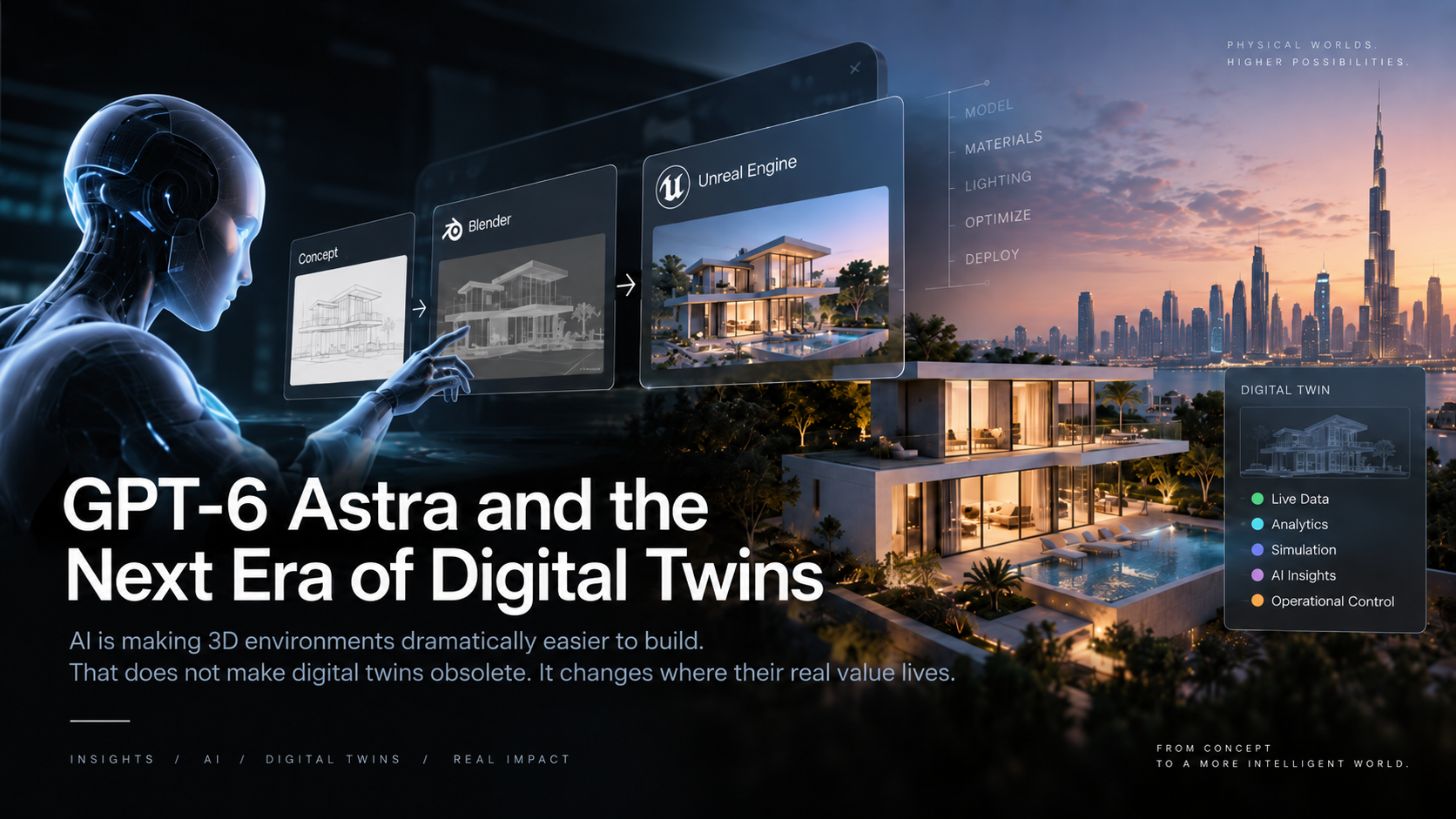
AI is making 3D environments dramatically easier to build. That does not make digital twins obsolete. It changes where their real value lives.
The release of GPT-6 Astra introduced an interesting demonstration that should get the attention of anyone working across architecture, real-time 3D, Unreal Engine, simulation, or digital twins.
OpenAI demonstrated Astra taking the concept of a house, modelling it in Blender, and turning it into a walkable environment in Unreal Engine 5. The result was not simply a generated image or an isolated 3D asset. Astra worked across professional creative tools to help construct an interactive environment that could be explored before the physical space existed.
At first glance, this raises an uncomfortable question for studios working in immersive technology:
If AI can increasingly build 3D environments itself, what happens to the digital twin market?
Our view is that the opposite of what many expect may happen.
Digital twins are about to become significantly more accessible, more intelligent, and ultimately more useful.
And that changes the opportunity.
The cost of creating the visual layer is collapsing
Historically, producing a high-quality real-time environment could involve several specialized workflows:
3D modelling, asset cleanup, materials, lighting, optimization, scene assembly, Unreal Engine implementation, scripting, testing, and deployment.
Even when architectural data already existed, moving from CAD or BIM assets into a polished interactive environment required significant manual effort.
Astra demonstrates how quickly this workflow is beginning to change.
AI systems are moving beyond generating text, images, and code. They are increasingly capable of operating the professional software used to create products.
That distinction matters.
Instead of asking an AI to generate a picture of a house, we can increasingly ask it to participate in building the actual environment.
This has the potential to reduce one of the largest cost centers in digital twin development: constructing and maintaining the spatial representation itself.
But the spatial representation was never the entire digital twin.
A 3D model is not a digital twin
The term “digital twin” has become increasingly broad.
Interactive architectural walkthroughs, property configurators, BIM viewers, and photorealistic environments are often described as digital twins.
Technically, however, a digital twin goes further.
Epic Games describes digital twins as accurate 3D representations continuously connected to real-world data, capable of ranging from visualization systems to autonomous systems that react to changes in their physical counterparts.
This distinction is important because AI is likely to commoditize the visualization layer much faster than the deeper layers surrounding it.
A useful way to think about the modern digital twin stack is:
1. Spatial Representation
The building, factory, hospital, machine, infrastructure system, or physical environment represented in 3D.
This includes geometry, materials, lighting, animation, BIM information, and scene optimization.
This is the layer where tools such as Astra may have the most immediate impact.
2. Interaction
The software layer that allows users to navigate the environment, inspect assets, change configurations, filter information, control simulations, and explore the system.
3. Data
The connections that make the environment useful.
CRM systems.
IoT sensors.
Building Management Systems.
ERP platforms.
Asset management systems.
Construction schedules.
Inventory.
Energy consumption.
Occupancy.
Equipment telemetry.
4. Intelligence
This is where the twin stops simply describing reality and begins helping users understand it.
Predictive maintenance.
Anomaly detection.
Operational forecasting.
Simulation.
Optimization.
Scenario modelling.
Natural-language interrogation.
5. Action
Eventually, the twin can move beyond displaying and predicting information.
It can recommend interventions, create workflows, dispatch maintenance, adjust schedules, or potentially control connected systems.
AI dramatically lowers the barrier to Layer 1.
The real opportunity sits increasingly in Layers 3, 4, and 5.
Real estate is already moving from visualization to decision-making
This shift was already underway before Astra.
In early 2026, Epic Games described an evolution taking place across real estate technology.
Historically, real-time 3D was primarily used to create a visual “wow factor”. Developers could showcase properties before construction, allow buyers to explore units, and create immersive sales experiences.
The next generation goes further.
Epic describes these systems as decision-making environments, where visualization becomes connected to pricing, configuration, construction, planning, and risk.
There are already examples of this model appearing in commercial real estate.
PropVR's digital twin work for DAMAC connects interactive environments to inventory and CRM systems, enabling real-time sales tracking and lead management. The same architecture can expand toward construction updates, occupancy, environmental data, lighting, utilities, and operational asset management.
That is where the market becomes particularly interesting.
Imagine opening a digital representation of a development.
You select a tower.
Instead of simply looking at it, you see:
74% sold
18 units available
Construction progress: 68%
Projected handover: Q4 2027
You select a floor.
Every unit changes visually according to availability.
You select an apartment.
Pricing, layout, payment plans, finishes, CRM activity, buyer interest, and availability appear immediately.
Then you ask:
“Show me every unsold two-bedroom unit below AED 2.2 million with a sea view.”
The environment updates.
That is no longer a virtual walkthrough.
It is a spatial interface into the business.
AI introduces another layer: conversational digital twins
Generative AI could change the way people interact with complex physical systems.
Traditional operational software requires users to navigate dashboards.
Find the right screen.
Select filters.
Interpret charts.
Understand which system contains which information.
A sufficiently connected AI-powered twin can invert that relationship.
The user can simply ask:
“Why did energy consumption increase in Building B this week?”
Or:
“Show me every HVAC unit behaving outside its normal operating range.”
Or:
“What happens to emergency department waiting times if patient arrivals increase by 25% tonight?”
Or:
“Which part of the production line is currently limiting throughput?”
Instead of forcing people to translate real-world questions into software interfaces, the system translates natural language into queries, simulations, and spatial visualization.
This could make digital twins significantly more accessible to executives, operators, sales teams, facility managers, and other stakeholders who have no interest in learning complex technical software.
Consider a hospital
A traditional hospital digital twin might visualize departments, patient movement, staff allocation, equipment, occupancy, and alerts.
An AI-native operational twin could go further.
A hospital administrator could ask:
“Simulate a 20% increase in emergency admissions between 6 PM and 10 PM.”
The twin could visualize the expected consequences.
Bed availability changes.
Waiting times increase.
Nursing workloads move.
Bottlenecks appear spatially.
The administrator could then ask:
“What happens if we move two nurses from Ward C to Emergency?”
The simulation runs again.
Then:
“Find the lowest-cost staffing configuration that keeps average waiting time below fifteen minutes.”
At that point, the digital twin has evolved from an interface into a decision-support system.
The same applies to industrial environments
Factories provide another obvious use case.
Imagine a facility represented through an Unreal Engine environment and connected to operational telemetry.
Production lines.
Robotics.
Conveyors.
Asset temperatures.
Cycle times.
Downtime.
Energy consumption.
Maintenance history.
Instead of monitoring those systems across fragmented dashboards, operators could explore them spatially.
Epic has already highlighted this value in infrastructure deployments, where digital twins combine real-world data with 3D environments to help operators identify not only that something is wrong, but exactly where the issue exists and why it matters.
Now introduce AI.
“Show me machines with abnormal vibration patterns.”
“Which asset is most likely to create production downtime during the next seven days?”
“Simulate shutting down Line B for four hours tomorrow.”
“What production schedule minimizes the impact?”
Again, the 3D environment becomes the interface.
The intelligence around it becomes the product.
This changes the economics of digital twin development
Perhaps the most important consequence of systems such as Astra is not a new feature.
It is economics.
Digital twins have historically been expensive to build partly because combining high-quality 3D environments, software engineering, integrations, infrastructure, simulation, and data requires multidisciplinary teams.
AI could compress several parts of that workflow.
Scene generation.
Asset preparation.
Materials.
Lighting.
Scripting.
Blueprint scaffolding.
Interface implementation.
Testing.
Documentation.
Optimization.
Eventually, increasingly automated pipelines could allow smaller teams to produce systems that previously required much larger production structures.
That does not necessarily mean digital twin projects should simply become cheaper.
It means projects that were previously economically impossible may suddenly become viable.
A small property developer that could never justify a major interactive experience may now be able to deploy one.
A manufacturer may be able to begin with one production line rather than digitizing an entire facility.
A hospital may start with emergency department simulation before expanding into a complete operational twin.
The addressable market expands.
But visualization itself is becoming commoditized
There is an important warning here.
If the value proposition of a company is simply:
“Give us your floor plan and we will make a beautiful interactive walkthrough.”
AI represents a serious threat.
The amount of human production required to create that output will continue falling.
Photorealism alone will not remain a defensible competitive advantage.
The differentiation moves elsewhere:
Data integration.
Simulation.
Operational understanding.
Artificial intelligence.
Product design.
Systems architecture.
Industry knowledge.
Business workflows.
Decision support.
The companies positioned only as visualization studios may find themselves competing against increasingly automated workflows.
The companies capable of combining spatial computing, AI, software engineering, data, and domain expertise may find the opposite.
Their potential market becomes larger.
The Digital Twin Maturity Model
At Mirai Studios, we believe it is useful to stop treating every 3D environment as the same category of product.
Instead, digital twins can be understood across a maturity curve.
Level 1: Immersive Twin
A high-fidelity interactive representation of a physical environment.
Useful for visualization, communication, training, sales, and stakeholder engagement.
Level 2: Connected Twin
The spatial environment connects to business systems such as CRM, BIM, inventory, construction data, or operational databases.
The twin begins representing the state of the business alongside the state of the physical environment.
Level 3: Live Twin
Real-time systems enter the architecture.
Sensors.
IoT.
Building systems.
Equipment telemetry.
Occupancy.
Environmental data.
The virtual environment continuously reflects its physical counterpart.
Level 4: Predictive Twin
AI and simulation allow the system to anticipate future conditions.
Failures.
Congestion.
Energy demand.
Staffing requirements.
Construction delays.
Operational bottlenecks.
Level 5: Autonomous Twin
The system can recommend or potentially execute interventions.
Optimize schedules.
Generate maintenance workflows.
Adjust connected systems.
Coordinate resources.
Respond dynamically to changing conditions.
The higher the maturity level, the less important the 3D model itself becomes.
The model becomes the interface through which increasingly sophisticated intelligence is delivered.
What GPT-6 Astra really represents
Astra should not simply be viewed as another model capable of generating impressive 3D content.
Its more important implication is that AI systems are becoming capable of participating directly in professional production environments.
Blender.
Unreal Engine.
Development environments.
Browsers.
Engineering tools.
Scientific tools.
Enterprise software.
OpenAI describes Astra as significantly advancing computer use, software engineering, visual judgment, and complex professional workflows.
This creates the possibility of something much larger than AI-generated assets.
It creates increasingly automated production pipelines.
Architectural files enter one side.
An AI-assisted system analyzes them.
Geometry is prepared.
Materials are created.
Assets are optimized.
Scenes are assembled.
Interactions are scaffolded.
Data structures are connected.
Automated tests inspect the environment.
Human specialists review, correct, and direct the system.
A production-ready experience emerges on the other side.
We believe workflows like this will eventually become standard.
The future of digital twins is not more 3D
The industry does not necessarily need another beautiful model of a building.
It needs better ways to understand physical environments.
Better ways to operate them.
Better ways to simulate them.
Better ways to sell them.
Better ways to predict what will happen inside them.
And better ways for humans to interact with increasingly complex systems.
AI reduces the cost of building the visual foundation.
Real-time engines provide the spatial interface.
Live data connects that interface to reality.
Simulation allows organizations to test possibilities.
AI adds prediction, reasoning, and natural-language interaction.
Combined, these technologies begin to form something substantially more powerful than the digital twins we have traditionally built.
They become intelligent spatial operating systems for the physical world.
At Mirai Studios, that is the direction we believe the category is moving toward.
And the arrival of systems like GPT-6 Astra may accelerate that transition considerably.
Want to talk through a project?
Mirai Studios partners with teams building AI products, platforms and digital twins.
Request a call